I really did not appreciate how it would be after surgery. Being a contact lens wearer I thought if maybe a bit like putting in a newer contact lens. However, both eyes feel like they are working like independently headlights and that I have put on someone else's glasses. Focusing is certainly odd and I am photosensitive. Don't get me wrong, each day there is progress. and it is exciting to realise the brain will fix it!
So, I decided to take the camera out with me on day five and to rely on the use of the camera focus system. Not seeing clearly, it will be interesting to look back at a later date and see things as the camera saw it. Thank you Karen for coming to help me out through the process.


Today in Cherry Hinton Park I observed some new visitors that were very much together. It is native to Africa south of the Sahara and the Nile Valley. Egyptian geese were considered sacred by the Ancient Egyptians, and appeared in much of their artwork.
Related to the shelduck, this pale brown and grey goose has distinctive dark brown eye-patches and contrasting white wing patches in flight. It was introduced as an ornamental wildfowl species and has escaped into the wild, now successfully breeding in a feral state.
Egyptian geese are frequently seen on ornamental ponds where they were originally purchased as decorative birds. Now can be seen in gravel pits, lowland lakes and wetlands. The north Norfolk coast holds the highest numbers and they can be seen on the Norfolk Broads.


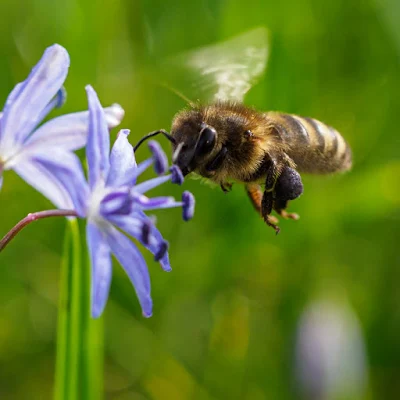
The warmth has enhanced Spring and many insects were pollinating the flowers. The arched Hazel walk was lined with aconites and snowdrops. Bees were attracted to the Puschkinia a plant native to the Caucasus and Middle East. One bee was observed to having a dark pollen sac and a varroa mite on its left flank. This could be recently infested from another bee in a flower food source. Varroa usually lodge in their undersides, sinking their teeth in the gaps between the tergites. That is the joints between the hard plates of the exoskeleton. These mites are now believed to feed on the "fat bodies" of the bee, not haemolymph as previously thought. Samuel Ramsey's work in Maryland USA pioneered work on the Varroa mite. The large dark lump on the leg is the pollen basket full of pollen. It is an unusual colour, but poppy pollen is black. There are pollen colour charts giving colours over the flowering season. The definitive identification would be microscopy. Usually bees don’t collect different pollens in one basket and therefore the pollen would be usually one colour. When they take it in the hive they stash it in an empty cell, or one with pollen in already. So when you look at a frame there will be pollen cells, in between honey cells around where the brood is, as the two are mixed together to make brood food. This is an organised economy of labour. I found it fascinating.